
To play like a pro, it’s essential that you learn how to breathe correctly. It’s the only way to produce notes that sound full and pleasing to the ear without running out of breath.
Blows and Draws
Each note on the harmonica is produced by blowing or drawing on the holes. In some instances, you’ll also change the pitch of a draw or blow note with a technique called bending (see How to Bend Notes on the Harmonica).
Blow notes (blows): Notes sounded by blowing into the harmonica
Draw notes (draws): Notes sounded by sucking air out of the harmonica
Nearly all beginners make the understandable mistake of assuming that to play blows they should just blow into the harmonica as they would a balloon, and that to play draws they should suck in air as they might do to smoke a cigarette. On the contrary, you should never do either—the sounds that result will be unpleasant and difficult to control.
Proper Breathing
The steps below show the proper way to play blows and draws.
Relax: No need to huff and puff. Breathing into a harmonica should feel like an extension of your natural breathing pattern. Before you start to practice, take a few deep breaths.
Start from the diaphragm: All harmonica breathing should originate from your diaphragm, the portion of your midsection just above your stomach and just below your sternum. Breathing from the diaphragm will allow you to breathe with power and control. It’s often easier to breathe from the diaphragm if you draw air in through your nose instead of your mouth. If you’re not sure what breathing from your diaphragm feels like, take a few breaths and monitor whether your shoulders rise and fall as you breathe. If you’re truly breathing from your diaphragm, your shoulders should not move.
Put the harmonica to your mouth: Lick your lips as well as a few of the middle holes of the harmonica. Then bring the harmonica to your mouth so that its holes push just past your lips and the outside of your mouth and are right in front of your teeth—don’t simply reach forward with your lips and put them around the holes. In proper position, your lips should rest on the cover plates and press up gently against the fingers of your left hand. In general, the deeper you can hold the harmonica in your mouth while still breathing comfortably, the better your tone will be. Make sure to maintain proper hand positioning, and keep your cup open about halfway.
Drop your lower jaw: Without changing the position of your mouth, lower your jaw slightly to expand the resonating space within your mouth. This will improve the tone of the notes you produce.
Take a few breaths: With the harmonica properly positioned in your mouth, exhale and inhale as you normally would into the holes near the middle of the comb. Continue breathing until your blows and draws begin to feel natural.
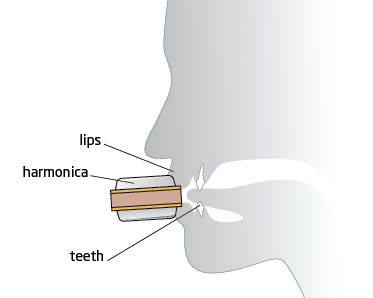
As you experiment with blowing and drawing, pay attention to your posture as well. It’s best to sit up straight with your shoulders back, not slouched. In time, you’ll get comfortable breathing properly in a more casual posture.
How to Build Harmonica Playing Endurance
Beginners often run out of breath when they first try harmonica breathing. You might also find that your lips crack and your mouth dries quickly as you play. This is natural. Playing the harmonica is a demanding form of respiratory exercise, and until you train your body for it, you’re likely to run out of breath after just a few minutes. The best way to overcome these problems is by building up slowly. Try proper harmonica breathing for five minutes the first time, then add five minutes each day for a week. Your body will adapt, and your endurance will improve quickly.


