
While a player can always widen his or her mouth over several holes (usually at the physical limit of five) and play chords and intervals all the time, the music usually sounds better when the melody is played one note at a time; while intervals may sound great for most beginner songs (usually written in the key of C or G, easily played on a key of C harmonica) as it "thickens" the sound, songs that are just slightly more advanced will sound weird if the interval is done improperly.
To play melodies, songs, and solos on the harmonica, you’ll use an embouchures (ahm-boo-shoors), or way of applying the lips and tongue to a wind instrument. In order to play single notes, numerous kinds of embouchures (mouth shape) are most commonly used:
Standard Tongue Block
This embouchure is favoured by many skilled players, as there are many effects that can only be done by using tongue block, and, in fact, necessary for jazz and classical playing. Simply put, it involves stretching the mouth over about four to five holes, and then using the tongue to block the holes.
On the other hand, since this is the most difficult embouchure, there are many methods of achieving it.
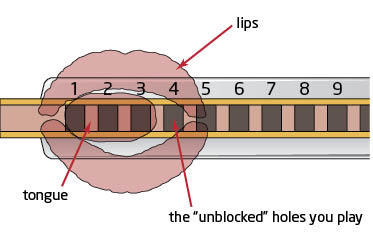
A few useful tips that will help greatly:
- Bring the harmonica deep in your mouth. If the mouthpiece hasn’t penetrated past the front teeth, you need to open your mouth wider and get the whole front of the harp pushed further back in the mouth. This has two effects: it gives you a fuller sound, and allow your breath to access to several holes.
- Tilt the harmonica so that the mouthpiece is tilted downward; that way, you can use more of the tongue to block, and you will find the technique less tiring.
- Push the tongue to the harmonica. Don’t put the tip of your tongue, but instead touch the tip of your tongue to your lower front teeth and gently push the tongue forward so that the top of your tongue contacts the harmonica. This will allow smooth transition as moving hole to hole.
- After you place your stretched mouth over the holes, jerk the tongue to the left on higher octaves, and to the right on lower octaves - then place the tongue over the holes, such that only one hole is opened for air. If you have problems of doing both side, try jerking the tongue to the left only
If it seems like you are making more than one sound, either press the tongue wider on the harp, or narrow your lips.
Advantage
- Allows playing of octaves, side-pull, pull, slap, self accompaniment, and many other techniques
- Allows legato and fast phrasing
- Louder volume; Lips can create higher pressure on the harmonica, which can create higher pressure in the cavity of mouth.
- Allow changing tonal quality through manipulation of oral cavity
- Allow longer playing; tongue block allow air flow into the mouth
Disadvantage
- Harder to bend with the tongue (but not impossible, if one can control airflow properly)
- Harder to utilize free-tongue specific techniques (such as singing into the harp)
Pucker
This is probably the instinctive single-note placing most players adapted: the lips narrowed to a small hole, so that the breath was directed into one hole at a time.
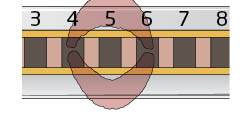
Advantage
- Learning curve is small (as I said, instinctive embouchure)
- Frees up the tongue for many other Blues-oriented effects, such as bending, tongue vibrato, and singing into the harp
- Good for very short staccato passages
Disadvantage
- Difficult to play legato, since it actually involves moving the entire harmonica from side to side.
- Lack or surplus of air can only be maintained through the nose.
Lip Block
However, in blues, a different lip block is used:
- Stretch your mouth across approximately 3-4 holes
- Tilt the rear of the harmonica upward (or tilt the mouthpiece-side downward), such that the lower lips can contact with the comb, which should properly block the non-playing hole on the both side of the current hole.
- Upper lips should be on top of the upper cover plate.
Advantage
- Same as pucker, but allow even more throat techniques (e.g. throat vibrato) and bending (as now you can also use your lips to control the embouchure)
Disadvantage
- Same as pucker, plus difficult to control the proper tone, since bending is now very easy.
- Not as loud since it's easy for the lips to get in the way, quieting the reeds.
U-Block
A complementation option require much greater dexterity on the tongue; curl your tongue into a "U", and use it to direct the airflow to the holes.

Advantage
- provide fast speed when moving up and down the harmonica
Disadvantage
- Require much more concentration; if one did not focus enough, there will be no airflow toward the hole.
- Require throat bending
- Unable to utilize tongue block specific techniques.
The U-block should be used mainly as a complement of the tongue block, as it allow rapid switching of notes that lies between the two outermost notes.


